Research Project
SAFE: Social Anxiety Focused Exposure
An experimental AI-powered job interview simulation system for social anxiety exposure therapy research. This project investigates the integration of generative AI and voice interaction technologies to create accessible intervention tools.
Research Abstract
Background
Social anxiety disorder (social phobia) affects approximately 7% of the population and significantly impairs performance in job interview situations, where individuals must present themselves to unfamiliar evaluators. AI technologies may help reduce accessibility barriers to traditional therapy, particularly given the shortage of mental health professionals [1]. Research indicates that individuals with social anxiety often avoid seeking help even from close contacts, showing preference for anonymous digital solutions [6].
Literature Review
A systematic literature analysis (n=13 sources) revealed that AI and virtual reality applications for mental health interventions constitute an actively researched field. AI research evolution shows increasing attention to explainable AI and user trust [4]. When developing AI systems for social welfare, ensuring accessibility and inclusivity for all user groups is essential [5]. However, challenges include defining system classification (medical device vs. wellness tool) and ensuring data protection compliance [2].
A meta-analysis of virtual reality exposure therapy (k=14, n=397) found a medium effect size (Hedges' g = 0.64) for social anxiety symptom reduction [9]. AI-based chatbots integrating CBT principles demonstrated statistically significant efficacy for mild to moderate anxiety symptoms, though severe cases require human therapist supervision [10], [7]. Chatbot reviews identified key success factors: clear therapeutic foundation, user involvement in development, and continuous content updates [11].
Studies show that individualized, adaptive simulations demonstrate greater efficacy than static scenarios [3]. Virtual reality job interview simulation research found that participants practicing in virtual environments showed reduced nervousness in actual interviews, with gradual difficulty progression being essential for effective outcomes [12]. Recent research on AI-enhanced simulations demonstrated that integrating generative AI into VR environments enables more realistic and adaptive scenarios [13]. Photorealistic AI-driven digital faces increase engagement and exercise efficacy, while physiological indicator integration allows system adaptation to user state [8].
Research Object
This project investigates the SAFE (Social Anxiety Focused Exposure) system—an experimental job interview simulation based on AI technologies. The system comprises three components: (1) generative AI for question generation based on user CVs, (2) AI-driven digital face for voice interaction, (3) planned virtual reality environment for exposure exercises. Market analysis of existing solutions revealed that CV individualization and dynamic question generation are not widely integrated into current systems.
Preliminary Findings
A needs assessment survey (n=25) showed that 100% of respondents reported experiencing anxiety before job interviews, with 50% indicating they had missed at least one interview due to anxiety. A pilot study (n=10) recorded anxiety level changes after SAFE sessions: mean reduction of -2.0 points (SD=0.82) on a 10-point scale. These preliminary results require confirmation through a randomized controlled trial with a larger sample.
Conclusions
Literature analysis and preliminary empirical data suggest that AI and VR technology integration for job interview simulation may be a suitable research direction for social anxiety interventions. Further research requires clinical validation, control group inclusion, and long-term impact assessment.
References
- Efe, A. (2022). The Impact of Artificial Intelligence on Social Problems and Solutions. Yeni Medya. DOI: 10.55609/yenimedya.1146586
- Rodrigues, R. (2020). Social and juristic challenges of artificial intelligence. Humanities and Social Sciences Communications. DOI: 10.1057/s41599-019-0278-x
- Biswas, A., Semwal, V.B., Singh, D. (2023). Artificial Intelligence for Societal Issues. Springer International Publishing. ISBN: 978-3-031-12418-1
- Dwivedi, Y.K., Sharma, A., Rana, N.P., Giannakis, M., Goel, P., Dutot, V. (2023). Evolution of artificial intelligence research in Technological Forecasting and Social Change. Technological Forecasting and Social Change. DOI: 10.1016/j.techfore.2023.122640
- Oliver, N. Artificial Intelligence for Social Good: The Way Forward. ELLIS Unit Alicante Foundation.
- Grosshans, M., Paul, T., Fischer, S.K.M., Lotzmann, N., List, H., Haag, C., Mutschler, J. (2024). Conversation-based AI for anxiety disorders might lower the threshold for traditional medical assistance: a case report. Frontiers in Psychiatry. DOI: fpubh-12-1399702
- Das, K.P., Gavade, P. (2024). A review on the efficacy of artificial intelligence for managing anxiety disorders. Frontiers in Artificial Intelligence. DOI: frai-2-1435895
- Ashrafi, N., Vona, F., Ringsdorf, C., Hertel, C., Toni, L., Kailer, S., Bartels, A., Kojic, T., Voigt-Antons, J.-N. (2024). Enhancing Job Interview Preparation Through Immersive Experiences Using Photorealistic, AI-powered Metahuman Avatars. arXiv. DOI: 2410.05131v1
- Chesham, R.K., Malouff, J.M., Schutte, N.S. (2018). Virtual reality exposure therapy for social anxiety disorder: A systematic review and meta-analysis. Psychological Medicine. DOI: 10.1017/S0033291718001393
- Farzan, M., Ebrahimi, H., Pourali, M., Sabeti, F. (2025). AI-Powered CBT Chatbots: Systematic Review. Iranian Journal of Psychiatry. DOI: 10.18502/ijps.v20i1.17395
- Casu, M., Triscari, S., Battiato, S., Guarnera, L., Caponnetto, P. (2024). AI Chatbots for Mental Health: A Scoping Review of Effectiveness, Feasibility, and Applications. Applied Sciences. DOI: 10.3390/app14145889
- Luo, X., Wang, Y., Lee, L.-H., Xing, Z., Jin, S., Dong, B., Hu, Y., Chen, Z., Yan, J., Hui, P. (2024). Using a virtual reality interview simulator to explore factors influencing people's behavior. Virtual Reality. DOI: 10.1007/s10055-023-00934-5
- Nofal, A.B., Ali, H., Hadi, M., Ahmad, A., Qayyum, A., Johri, A., Al-Fuqaha, A., Qadir, J. (2025). AI-enhanced interview simulation in the metaverse: Transforming professional skills training through VR and generative conversational AI. Computers and Education: Artificial Intelligence. DOI: 10.1016/j.caeai.2024.100347
Interactive Demo
The SAFE prototype demonstrates AI-powered job interview simulation with personalized question generation and voice interaction through a digital interviewer avatar.
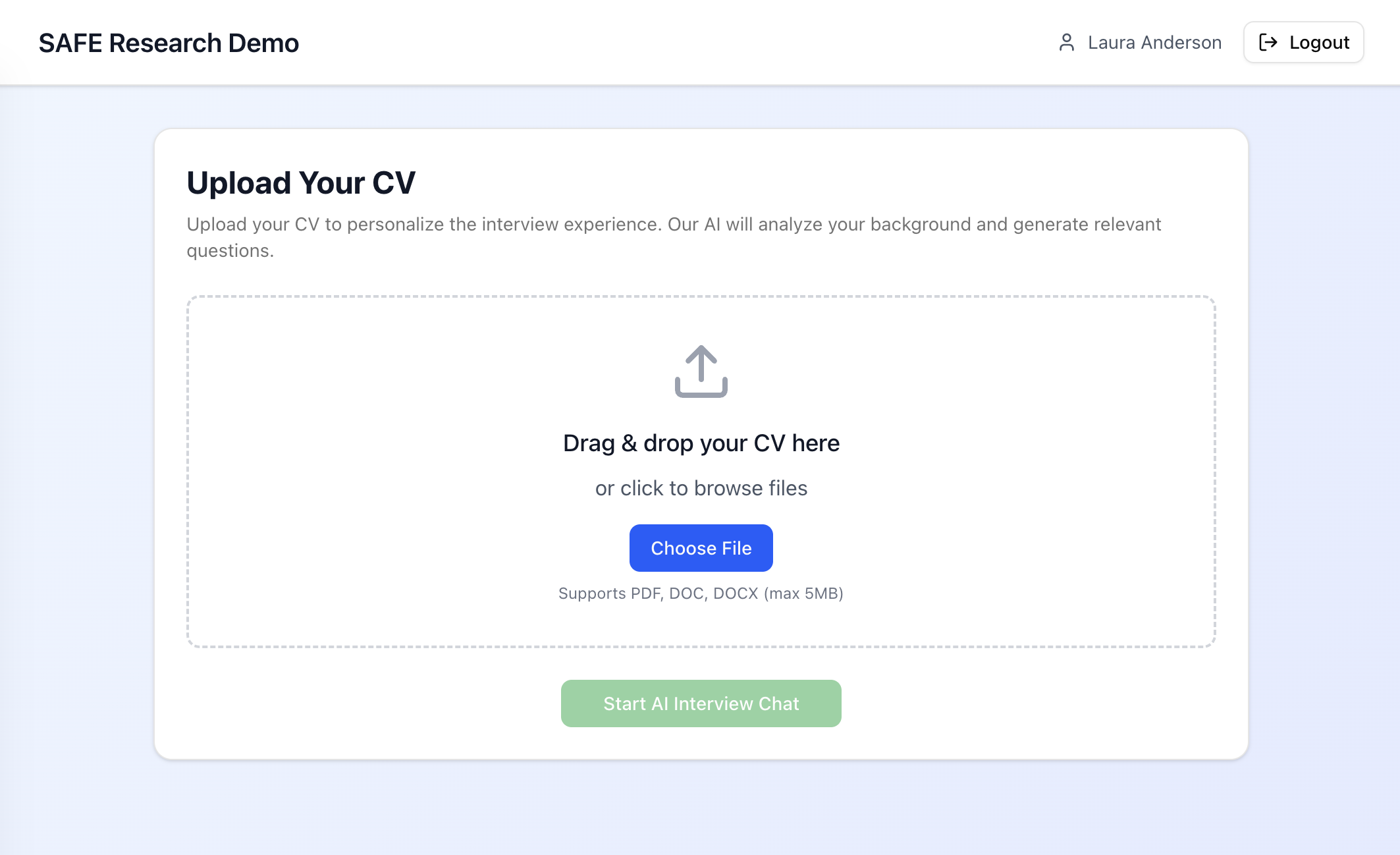
1. CV Upload & Analysis
Users upload their CV which is analyzed by AI to generate personalized, context-relevant interview questions based on their experience and skills.

2. AI Avatar Interview
An AI-driven digital interviewer conducts the simulation with natural voice interaction, adapting questions based on user responses.
Demo Features
Interested in trying the demo? Request access for evaluation purposes.
Research Domains
The project spans three interconnected research areas requiring interdisciplinary collaboration.
Understanding the mechanisms of social anxiety in evaluative contexts and the effectiveness of graduated exposure interventions in controlled digital environments.
Examining user experience, trust, and therapeutic rapport with AI-driven conversational agents in sensitive mental health applications.
Addressing regulatory classification, data protection, accessibility requirements, and responsible AI deployment in healthcare contexts.
System Architecture
The prototype consists of three modular components that can be independently evaluated and refined.
Large language model processes CV data to generate contextually relevant interview questions tailored to the user's background.
Digital avatar with speech synthesis and recognition capabilities for conducting simulated interview dialogues.
Pre- and post-session self-report measures to collect data on subjective anxiety levels for research analysis.
Research Collaboration
Research Gap
Traditional exposure therapy for social anxiety requires controlled therapy settings with limited real-world practice opportunities. Current approaches face barriers: fear of disclosure, limited availability of safe practice environments, and economic constraints for extended intervention.
Current Status
- • Functional prototype with CV-based question generation
- • Voice interaction with digital avatar
- • Seeking clinical validation partners
Collaboration Sought
- • Clinical psychology (anxiety disorders, exposure therapy)
- • Digital therapeutics validation
- • Ethics in AI healthcare applications
Principal Investigator
Ignas Markauskas
Principal Investigator, SAFE Research Project
Leading the SAFE research project at MB "Imarkas" R&D division. The project is based on systematic literature analysis and preliminary empirical validation, contributing to EU Horizon Europe digital health research priorities.
Contact
For collaboration inquiries or questions about the SAFE research project.